

By John F. Pappone
I arrived in Japan mid July of 1964 at the ripe old age of eighteen, ready to begin my tour at Kamiseya in the “Land of the Rising Sun.” For the next two years and seven months, this would be my home away from home.
Much was happening in the world at that time, including an event that took place shortly after my arrival. On the East coast of North Vietnam is the Gulf of Tonkin, the location of an incident that took place on August 2, 1964. As the story is told, and still somewhat refuted, an American destroyer, the MADDOX was attacked by the North Vietnamese. History tells us that this incident led to the escalation of the United States involvement in the Vietnam War. Although a very important newsworthy item, as a young new “boot” in the Communication Technician world, it was just that, another news story. The event would loom larger in my life as the witnessing of so many young Marines, Sailors and Soldiers would pass through our area heading towards “harm’s way.”
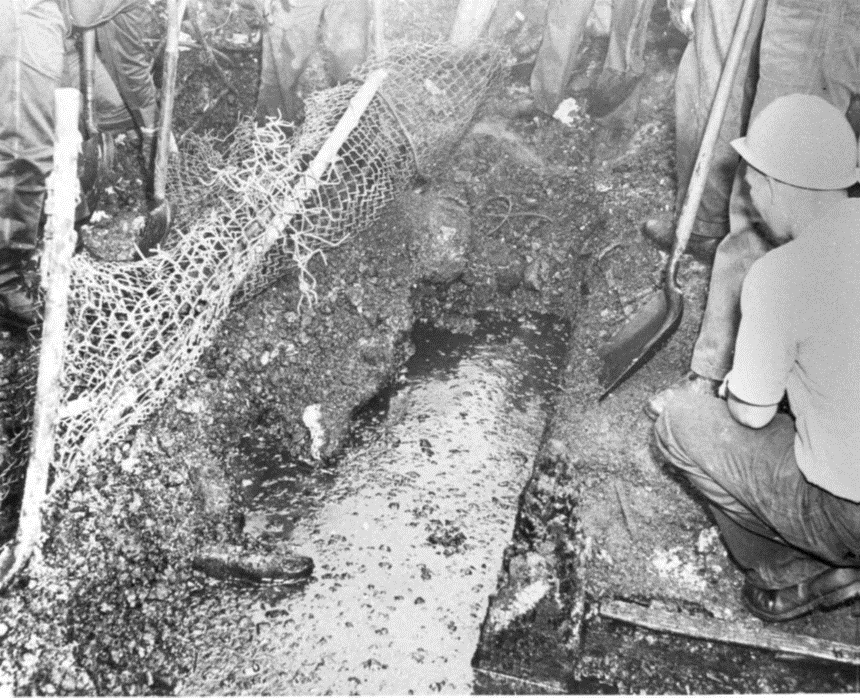
After the fire is out the recovery process begins.
A section of Yokohama that was predominately made up of tiny bar rooms located on tiny streets or alley ways was known as “Chinatown”, the backdrop for many good times and memories that are being shared to this day. It was here that the results of the so called “Gulf of Tonkin” incident was unfolding, not realizing that the next ten years or so would bring so much controversy both militarily and politically to our great country.
Even with war and other unpleasant events there was time for entertainment, and a major venue occurred in October of 1964, when Tokyo was home to the first ever summer Olympics in Asia. How I managed to be witness to this historic event I will never know, but I do recall attending a swimming event and almost getting to see a basketball game. It was during these early days that my first new friends were made, Ron Oprendek, Rocky Miele and Vic Robinson just to name a few.
As is the case with friends, there always seems to be a common bond that attracts, and with Ron and Vic it was music. Vic was a frustrated guitar player, who liked strumming cords while singing mostly rock and roll tunes. We would go to the Chapel Annex where an old upright piano was begging for attention. A few new guys came around, Joe Weber being one of them, and before you knew it, we were forming our own little group we named “The Janitors”. I was able to find an old snare drum along with a few old pieces of hardware, a vintage Zildjian cymbal and I became the official drummer for the group.
It wasn’t long after we formed this pick-up group that we really began to get serious, seeking out more members to enhance the sound etc. we grew the group to seven members, three vocalists. During our peak, I must say, we were knocking em’ dead playing gigs at the EM (Enlisted Men’s Club), Officer’s Club, Hyama Beach, the Zebra Club and a posh club on the Ginza known as the ACB Club.
The band members Included:
Singers:
Pete Runnels – Marine
Charlie Cannon – Sailor
Frankie Ines – Marine
Keyboard: “Rusty,” a dependent, dad was an officer
Lead Guitar: Joe Bruno – Marine
Rhythm Guitar Chuck Jones – Navy
Bass Joe Weber – Navy
Drums John Pappone – Navy (yours truly)
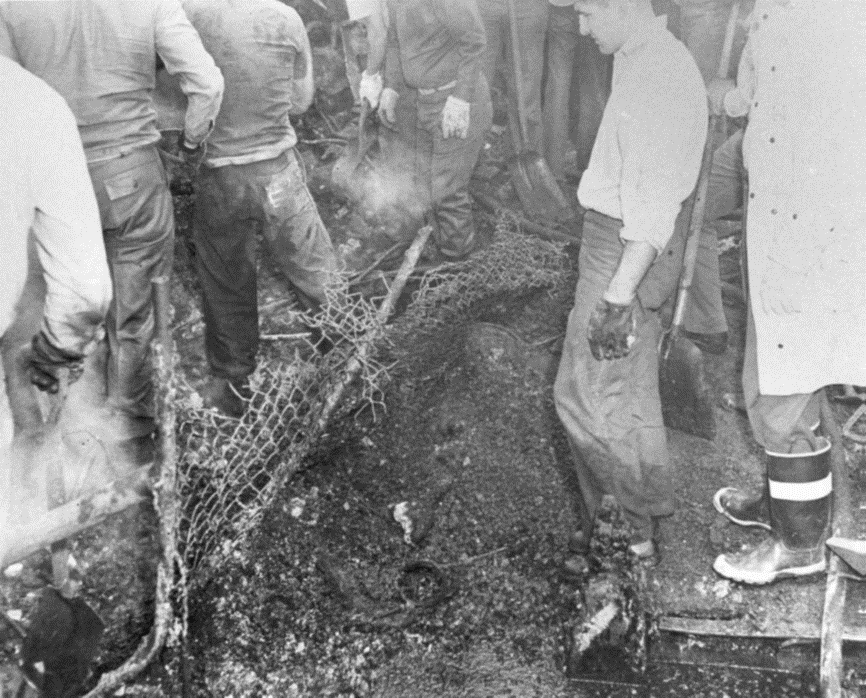
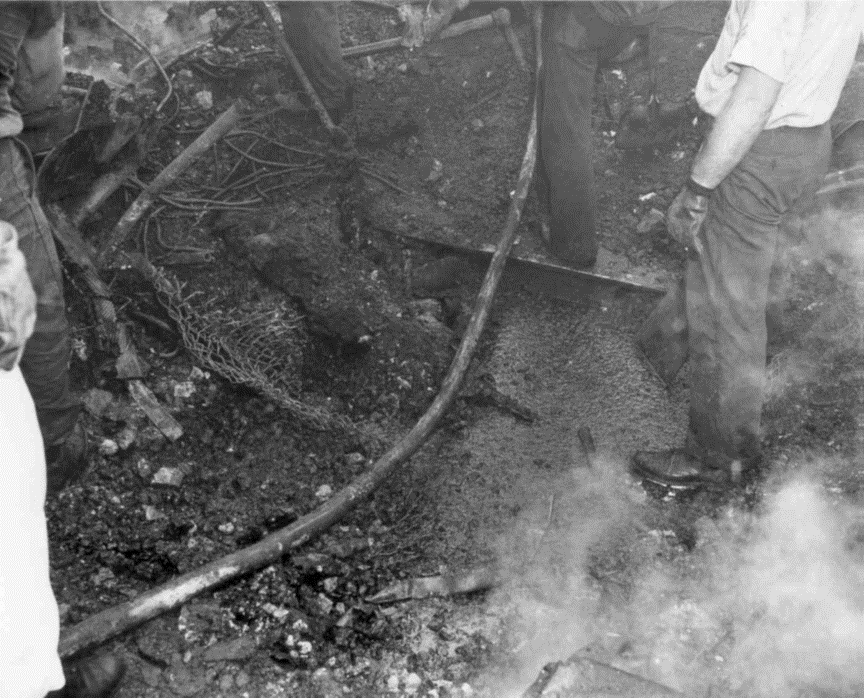
Shortly after the group was formed I made Third Class Petty Officer and did some time in “Blue Badge” room in charge of guys who were waiting for their final Top Secret Clearance to be issued. If my memory serves me right, this all occurred during the summer of 1965, a period of time at Kami Seya that was very exciting for me. It was also the year that a tragic event took place, one that to this day haunts me and causes me to reflect on that fateful night. I’m speaking of the horrible fire that took place on September 24th, 1965 in our secured working spaces known as the Tunnel.
I was between my Eve and Day watch, meaning I was in the section that was to relieve section two, the watch that was involved in the tragedy that took twelve young lives. I recall playing cards in my cube that evening and probably hitting the sack sometime before midnight. The next thing I knew, we were awoken by yelling, loud noises and bright lights. “The T’s on fire, the tunnel is on fire!” were the words that were repeatedly being yelled.
I remember waking up Ron Oprendek alerting him to the news while dressing in fatigues to obey the order to head for the Tunnel. The sky was illuminated with bright orange colors as everyone scurried around in total confusion. One of the first scene’s that caught my attention was that of a “BP”, border patrol man having his camera confiscated by two marines. Debris was flying in and around the Tunnel area that appeared to be papers coming from the complex. A Japanese helicopter hovering above, almost stationary in flight, was soon escorted out of the secured area by two Navy jets that flew in from near by Atsugi Naval Station.
The Japanese fire department was on sight, but I didn’t realize they were not allowed to enter or go beyond a certain point. Much of that information was not clear until the next day or the days that followed. I can’t say as I remember how long I was at the scene, but I do know I wasn’t much help and that the word was given to clear the spaces, probably because those involved in containing the blaze needed to organize the fire fighters. I do remember not sleeping for the rest of the night and well into the next day, which was the absolute worst day spent on that base.
Early that morning, our first muster was called in front of one of the barracks. There were some officers and chiefs calling for complete quiet as they began the alphabetical reading of names. As I recall, they were reading names of all personnel stationed on our base to determine who was present and who was missing. Knowing most of the 12 that perished in the fire, it was unsettling to hear names of those and not hearing a response. The quiet was deafening in some ways. I’m not sure how the process went, but we mustered several times to go through the same procedure. Each time, we were becoming more and more convinced of those same few names that never had a response.
I’m not sure if it was that particular day or maybe the next when the actual confirmation of the dead was determined and announced. I do remember how sick many of us felt when the news became official. I believe it was day two after the fire that the buzz was out that this tragedy had major impact on the news worldwide causing many of us to want to call home sooner than later. I remember manning a phone bank in one of the barracks, and having the job of maintaining connection with an international operator to connect to various homes throughout the U.S. My home was one of them, and I’ll never forget hearing my mother’s voice when she heard mine. I guess we hadn’t realized that this was major news and we needed to tell our loved ones that we were okay.
The days and weeks that followed were filled with talk of the tragedy. Unanswered questions led to much “scuttlebutt” and fire procedures became increasingly the order of business. As I mentioned, I did know most of the victims, but one in particular was a friend that I still think of often. His name was Gregory Scott “Red” Williams, a quiet young man from Illinois. As of this writing, we are approaching the 40th anniversary of this tragedy, and through the magic of the world-wide-web, I have been in introduced via e-mail to “Red’s” sister Valery. Approximately one year ago, while searching the net, Valery came across my e-mail address, sent me a brief message explaining who her brother was, and as they say, “the rest is history.” Good Lord willing, Valery will be making the trip to Pensacola in September of this year to attend a memorial service at Corry Station. A fitting story to put closure to this piece of history experienced by many!
Life went on, and I, along with my buddies, found myself getting back to our routine. Although never out of our minds, we thought of our fallen hero friends often and raised many a toasts to them as we populated the Bacchus, Red Shoes, Golden Cup and many other “heading rolling” establishments in Yokohama. Although I had better than a year left on my tour after the fire, I did find solace with my music and spent many a free night playing drums at the Stork Club (aka Piano Bar) in Chinatown.
Forty years: where did it go? I look forward to reuniting with many of my Navy and Marine friends this coming September to share the many memories of years gone by, but most importantly honor the memory of ten Sailors and two Marines who gave their lives and whom I will never forget. R.I.P.
Source: US NCVA Special Publication, Kamiseya 40th Anniversary Fire Memorial
 Station HYPO
Leave a comment