
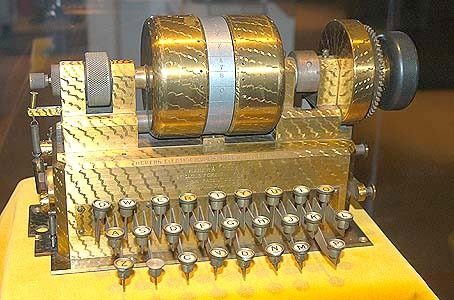
Featured image: Hebern Cipher Machine
By 1931 the Navy had tested and discarded the double‑printer model of the Hebern Cipher Machine and had placed an order for 30 single printer Hebern Cipher Machines for service tests. An early form of “strip cipher” was introduced by the Navy as a step in the transition from codes to ciphers and to serve as an interim system until the Electric Cipher Machine could be perfected. The Army took a dim view of the Electric Cipher Machine at that time and attempted to induce the Navy to abandon it: under the circumstances “collaboration” was impossible.
In 1924 the Navy established a Communication Intelligence Organization under the Code and Signal Section of the Office of Naval Communications with covering title of “Research Desk”. The initial allowance was one officer and four civilians, latersupplemented by two enlisted radiomen. An immediate start was made on establishing intercept stations in the Pacific Area, getting the Washington Cryptanalytic Unit to function, training personnel, and planning for future expansion. Training was accomplished through technical manuals (which had to be prepared) and correspondence methods plus temporary duty “under instruction” in Washington. Intercept stations were established as trained personnel became available in approximately the following order: Shanghai, Oahu, Peking, Guam, Manila, Bar Harbor, (Maine), Astoria, (Oregon), and Washington, D.C. Minor intercept activities were (HF) D/F stations. Advanced communication intelligence (CI) (decrypting) Units were established in the Manila Area in 1932 and at Pearl Harbor in 1936, serving Commander in Chief Asiatic Fleet (CINCAF) and Commander in Chief Pacific (CINCPAC) respectively. Beginning in 1935, selected Naval Reserve officers were ordered to Washington normally for a two‑weeks’ “training cruise” and given advanced cryptanalytical instruction and training. In 1938 the “Communications Security Group” successor to the (“Research Desk”) took over the operation of all Naval D/F facilities. The growth of the Navy communication intelligence (COMINT) organization was slow, steady, and uninterrupted until the fall of France (June 1940) and the President’s proclamation of the Unlimited National Emergency (June 1941) permitted calling to active duty trained (or at least partially trained) Naval Reservists previously earmarked for communication intelligence (CI) duty. The strength and growth of the Navy COMINT Organization is shown on the following table:

Once intercept stations had been established at Shanghai and Oahu, and a few radio operators had learned to copy the Japanese Morse Code, the U.S. Navy was off to a flying start in its study of Japanese Naval messages due to a fortuitous circumstance. About 1922 a shock‑team of The Federal Bureau of Investigation (FBI), Office of Naval Intelligence (ONI), and New York Police representatives succeeded in “picking‑the-lock” of the safe of the Japanese Consul General in New York and discovered a Japanese Naval Code belonging to a Japanese naval inspector. This was photographed, page‑by‑page, over a period of time, and re-photographed a year or two later to pick up extensive printed changes. The cipher used with this code was not too difficult ‑ and we literally surfeited with blessings. The one or two available translators could not possibly go through all the intercepted messages so it was necessary to sort out the high priorities, important originators, important addresses, etc., and thus skim off the cream. The Japanese used this code until December 1930, thus giving U.S. Navy authorities (CNO, War Plans, and Naval Intelligence) a complete picture of the Grand (Japanese Naval) Maneuvers of 1930 including Japanese Naval War Plans, strategic concepts, and the fact that the maneuvers were a “cover” for 100% mobilization of the entire Japanese Navy. When the Japanese Army began the invasion of Manchuria a few months later, its rear was guarded by Naval Forces superior in strength to the peace‑time U.S. Navy, and CNO knew it.
In the Army, the period 1930 to 1935 was one of energetic revival. In those years the work was under the direction of Mr. William F. Friedman, who has continued to be a leader in the field and who is presently associated with Armed Forces Security Agency (AFSA), the joint Army‑Navy‑Air Force cryptologic center in Washington. The first job was to reassemble former personnel and enlist new recruits; a training program with instructional literature was organized and it is noteworthy that the first time a total cryptologic activity, (the construction of our own ciphers) was envisaged. There was still no Army intercept service, as we understand it today, but raw material was clandestinely obtained through “backdoor” arrangements, and the secrecy surrounding the work was such as, in the backwash of shock following the Stimson ultimatum, to preclude showing the results of the effort to anybody but the Chief Signal Officer ‑‑ Intelligence Section, usually Army (G‑2) was proscribed. In these depression years funds were extremely difficult to get, especially in view of the nervous secrecy engendered by the Yardley 3 disclosures. Perhaps the greatest triumph of the Army cryptanalytic group at this time of stringency and uncertainty was the establishment under the Signal Intelligence Service of a training school for officers, which grew from a student body of one in 1931 to about a dozen ten years later.
When the newly established Navy COMINT Unit began its study of Japanese Diplomatic systems in 1924‑25, the Army steadfastly refused to give the Navy any assistance or to admit that “Yardley’s Black Chamber” in New York City ever existed. In 1931 the Navy set an example of collaboration by giving the Signal Corps all Japanese Diplomatic keys which had been recovered since the abolition of the “Black Chamber” plus full data on new systems which had come into being since that date. The Army more or less took over the Japanese Diplomatic systems leaving the Navy free to devote its efforts to Japanese Naval systems. From that time on there was complete interchange between the Army and Navy regarding all technical features of Japanese Diplomatic as well as exchange of important translations. During the winter of 1935‑36 a new Japanese diplomatic system came into effect which the Army correctly estimated to be a machine system. The Navy suspected that it might be similar to a Naval Attaché cipher machine, which the U.S. Navy was currently reading, if not the same machine. The Navy gave the Army full technical details of this machine, plus a “reconstructed” equipment, and the techniques of its solution. Shortly thereafter the Army was reading the messages in this diplomatic system, subsequently called the “Red” Machine. Later on the “Red” Machine disappeared from the major embassies and reappeared in less important diplomatic posts. The new machine (subsequently called “Purple”) had some similarities to the “Red” Machine but was much more complex. As far as technical difficulties are concerned, the Army’s solution of the Purple Machine was the masterpiece of cryptanalysis in the war era. It required about two years time plus copious “cribs” and translations, and literally drove some of the participants to the verge of nervous breakdown.
The Navy assisted by fabricating “reconstructed” Purple Machines at the Naval Gun Factory. These were distributed to the War Department, Navy Department, CINCAF, and subsequently to the British COMINT organization in London. Solution of the Purple Machine itself was not the whole story by any means because a new key was used each day and had to be recovered each day, as well as the special keys for special services which were introduced later on. The Navy assisted the Army in the recovery of these daily keys and eventually developed a system of “predicted keys” whereby older keys could be reused after going through certain manipulations. The all important messages sent from Tokyo to Washington on 6 and 7 December 1941 were in “predicted” keys so the only delay in reading these messages was decoding and editing.
The Navy COMINT Organization always recognized that its proper targets were the major Navies of the world ‑ particularly the Japanese Navy. It began with the solution of diplomatic systems in 1924 – for the training of personnel (and) because the messages were on hand – having been relayed by U.S. Naval Radio Stations for several years. No Japanese Naval messages were then available and there were no intercept stations or operators capable of copying them. Work on Japanese diplomatic systems was continued, partly for training and partly to be independent of U.S. Army sources, to say nothing of orders of higher authority. During the hiatus between closing of Yardley’s “Black Chamber” and the establishment of the “revised” Signal Corps Unit in Washington, the Navy was the only source of Japanese Diplomatic COMINT: attempt was therefore made to translate all diplomatic intercept during this period. For the rest of the time, up to 1938 or 1939, Navy interest in Japanese Diplomatic centered in solving the ciphers and recovering the keys. The Commander in Chief (CinC) Asiatic Fleet was kept supplied with Japanese Diplomatic ciphers and keys from 1931 to 1941, and his Fleet Intelligence Officer made such translations as were required by the CINCAF. In 1938 or 1939 it was discovered that the same safe which yielded the Japanese Naval Code in the early 1920’s was a never‑failing source of supply for “effective” and “reserve” diplomatic ciphers and keys with the exception of the two machine systems. This enabled the Navy Department to provide CINCAF and the Army with Japanese Diplomatic Ciphers and Keys before they came into use. At that time the U.S. Navy was devoting 100% of its cyrptanalytic effort and about 90% of its translating effort to Japanese Naval Codes and Ciphers, leaving Japanese Diplomatic systems to the U.S. Army almost exclusively. Later, during the winter of 1940‑41, when the White House and the State Department became seriously interested in Japanese Diplomatic messages, the picture changed.
Once the Purple system became readable and the need for current Japanese Diplomatic systems was felt, the War Department COMINT Unit did not have enough Japanese translators to handle the job efficiently. Furthermore it was under pressure to divert some of its cryptanalysts and crypto‑clerks to German crypto systems. Therefore the Army requested the Navy to assist with the Japanese Diplomatic system on a 50‑50 division of effort. After studying and rejecting two earlier proposals it was agreed to divide all Japanese Diplomatic “processing” (decrypting or decoding) plus translation on a daily basis, the Navy taking the odd days and the Army the even days, as the simplest way to evenly divide the work load and prevent duplication of effort. A few months later Naval Intelligence and G‑2 arranged for the dissemination of Japanese Diplomatic traffic to the White House and State Department on a monthly basis, the Navy taking the odd months and the Army the even months.
Source: SRH-149
 Station HYPO
Leave a comment