
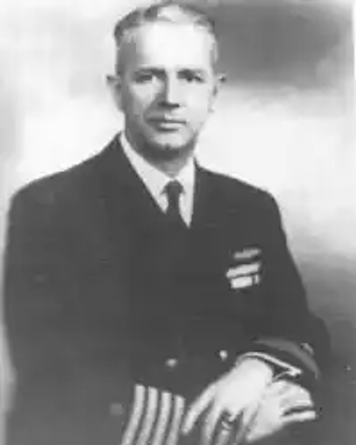
Featured image: Captian Laurance Safford, USN
This five-part series is Captain Laurance Safford’s version of pre-Pearl Harbor communication intelligence history. This paper was prepared between 21 and 27 March, 1952.
One of the first U.S. Naval Officers to specialize in the new field of cryptology, CAPT Safford headed the newly‑established Cryptographic Research Desk in the (OPNAV) Code and Signal Section from 1924‑1925. His efforts to improve U.S. communications security aided substantially in the development of machine ciphers. During World War II he served as Assistant Director of Naval Communications for Cryptologic Research. From 1949 through 1951 was Special Assistant to the Director, Armed Forces Security Agency. In 1958 Congress awarded him $100,000 for his wartime inventions in lieu of patents. He is remembered as one of the pioneers of naval cryptology.
Prior to 1917 United States activity in the field of Communications Intelligence 1 was sporadic, and there is little recorded of it. For all practical purposes the history of American cryptanalysis begins with our entry into World War I. Codes and cyphers at that time, even those used to carry the most sensitive information, were by current standards naive. They were hand‑coded and hand‑applied cypher systems usually overlying double‑entry code books, the attack upon which required skills and patience but not the elaborate electronic and tabulating devices of today. Consequently, the codes which this Government “cracked” from 1917 to 1919 were handled by a small group of lexicographers, mathematicians, and people who had acquired some background in what was then the hobby of cypher construction, usually related to some such cult as the “Baconian Theory.”
The War Department set up the first organized cryptanalytic office in June 1917, under Mr. H.O. Yardley, an ex-State Department telegrapher who had taken some interest in cryptology, or cypher construction. The strength of this office, at first three people, grew rapidly, was subdivided into functional sections, and at the conclusion of the War had a table of organization of some 150 persons with an annual budget of $100,000. Its security regulations were primitive. Cyphers were broken and code values were recovered entirely by hand process. The volume of traffic handled by the group was nevertheless respectable, and the results of their work on the military, diplomatic and economic fronts were important enough to impress both the General Staff and G‑2. But its budget for fiscal year 1921 ran into opposition, and during that decade was steadily diminished, falling at length to $25,000. No research was carried on; there were no training activities, no intercept, no direction finding studies. The personnel had fallen to six. The coup‑de‑grace was given in 1929 a few weeks after Mr. Stimson 2 became Secretary of State. By default the records and physical possessions of “The American Black Chamber” fell to the Signal Corps of the Army.
The Navy Department attempted no cryptanalytic work during 1917-1918 but set up a system of medium frequency direction finder (D/F) stations along the Atlantic Coast for tracking German submarines operating in the Western Atlantic. After the Armistice these Navy coastal D/F stations were diverted to use as aids to navigation but were retained in full operation until “navigational D/F service” was turned over to the Coast Guard in 1941. Although the U.S. led the world in the development and use of the intermediate frequency direction finder (IFDF) it lagged badly in development of the high frequency direction finding (HFDF). Finally, in 1937 or 1938, the Naval Research Laboratory developed a HFDF that would work. Production was undertaken at the Naval Gun Factory, installations were made at selected coastal D/F stations in the continental U.S., and overseas “strategic” (HF) D/F stations were established at Manila, Guam, Midway, Oahu, Dutch Harbor, Samoa, Canal Zone, San Juan, and Greenland. By 1939, the “strategic” D/F organization was successfully tracking Japanese warships and merchant vessels in the Western Pacific; the Japanese had been tracking U.S. Naval ships since 1934. By 1940, the East Coast strategic D/F net was successfully locating and tracking German submarines in the Atlantic. About May 1941, the Navy Department and British Admiralty began exchanging D/F bearings on German U‑boats: U.S. D/F stations compared favorably with British D/F stations in this respect. These U.S. Navy D/Fs were also supplied to all Naval Air Stations for air navigation and lost plane procedure, and were made available to the Federal Communications Commission (FCC) and to the Army. In 1940 Monsieur Busignies fled to America from Paris, ahead of the advancing German armies, taking with him complete plans for a new and radically superior fixed‑Adcock type of HFDF. The Navy placed a production contract for the Busignies D/F through the Federal Telephone and Telegraph Company. It was necessary to re‑engineer the Busignies D/F to take standard American tubes, 60‑‑cycle power supply, and otherwise adapt it to American use and manufacturing processes; as a result the Busignies D/F did not get into service until 1943. The Collins Radio Company submitted to the Navy the plans of a new and radically different type of rotating D/F about the same time as M. Busignies. The Collins D/F was rushed into production and went into service in 1942. On 7 December 1941, the U.S. Navy was using the DT‑1 and DT‑2 (equipment designators) HFDFs of Navy design and construction; and had a continuity of direction finding effort since 1917.
On the security side, the Navy built up during 1917 and 1918 an integrated organization (The Code and Signal Section of Naval Communications) for the compilation, production, distribution and accounting of Codes and Ciphers. The Registered Publication Section was divorced from the Code and Signal Section in 1923 and its functions were expanded to include distribution and accounting for all secret and confidential documents prepared by the Navy Department and bearing a register number. During 1917‑18, the U.S. Navy relied heavily on cryptographic advice given by the British Admiralty, whose famous “Room 40” led the world in practical cryptanalysis at that time. The Code and Signal Section, maintained at reduced strength after the Armistice, gradually built up a War‑Reserve of Naval Codes and Ciphers and made plans for technical improvements. As early as 1922 the Navy recognized that the future of secret communications lay in machine cipher systems rather than in its current systems of enciphered‑codes, and sponsored the development of the Electric Cipher Machine from that time on.
Source: SRH-149
 Station HYPO
Leave a comment