
By John T. Korn
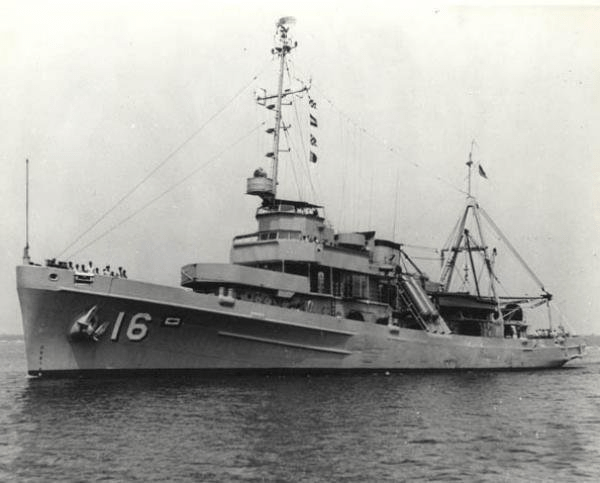
In June 1965, TRINGA departed SubBase, New London, Connecticut for the North Atlantic. Her mission, in part, was to act as a distraction while the cablelayer, USS NEPTUNE (ARC-2) worked on the Sound Surveillance System (SOSUS) array in the Greenland, Iceland, United Kingdom (GIAK) gap. Very few of those aboard TRINGA even knew what the term “SOSUS” meant and we saw little of the cablelayer which was operating over the horizon at some distance from TRINGA.
After a repair call in Reykjavik, Iceland and a port call in Holy Loch, Scotland, TRINGA proceeded to her assigned station. Within a few days we were overflown by Ilyushin, IL-28s (Badgers) and Tupolov TU-95s (Bears). These over flights continued on an almost daily basis and soon a Soviet Naval destroyer type appeared and took up station off TRINGA’s port side. Every course change was followed by the Soviets. A little humor was added when TRINGA’s captain had the ship’s signalman send over a message complimenting the Soviet skipper on his very good ship handling – he promptly returned the compliment.
Prior to her New London departure, the TRINGA ship fitters constructed a mini-like submergence vehicle. One day it was lowered into the water off the fantail while a few of the line handlers, headsets on, pretended to be conducting some type of operation. The Soviets displayed great interest in this tomfoolery; the entire crew, even some of the engineroom crew, boilersuits and all, came up on deck to see what was happening.
However, Soviet interest was really peaked when the TRINGA crew assembled on the forecastle for what looked like a “political rally.” At that time the Navy allowed beards and I had grown a very full one. The ship’s first lieutenant had loaned me a khaki fatigue cap and had given me a very large cigar. Indeed, I looked like Fidel Castro himself uttering nonsense gibberish and gesturing wildly with my arms. The assembled crew would cheer loudly from time to time much like the crowds assembled for Castro’s political harangues.
The Soviets lined the rail, and I’m quite sure they were observing the first “political rally” being held on a U. S. Naval vessel by a “Political Kommisar.” They were seen taking several photographs and I am more than confident that somewhere, deep in the inner recesses of Moscow’s Naval Headquarters Archives are photos of “CASTRO KORN” rallying the troops. The Soviets probably thought that only in their own Navy were there “Political Kommisars” on board. Yes, merriment reigned supreme on that day in the North Atlantic.
Returning for a moment to SOSUS, upon my return to Fort Meade, I spoke with Emil Levine, who asked me about the trip. Then he said, “Take a look at this.” It was a full page story published in the New York Times, describing pretty much in detail, the operation, function and location of many of the arrays. What little knowledge one had beforehand was indeed greatly enhanced after reading the article. So much for secrets and security.
Speaking with Lew Bearden and another crewmember in San Antonio, Texas we had quite a few chuckles over that voyage. In trying to get his Blue Nose Certificate (given to those crossing northern latitudes greater than 66° 32’ North) one of the fellows said in his research he was unable to find any information regarding this particular mission/operation. Upon further research, I found that according to the Dictionary of American Fighting Ships, TRINGA was laid down in Savannah, Georgia in July 1945, launched in June 1946 and commissioned in
January 1947. She began and ended her long and varied history at SubBase, New London where she was decommissioned in September 1977. While operational, the vessel had a long and distinguished career, some of which included assisting in the refloating of the USS MISSOURI (BB-63) which had run aground off Hampton Roads, Virginia. in January 1950, aiding USS HARDER (SS-568) which had broken down off Ireland in August 1953 and in the salvage of RC- 21 in the fall of that same year off Portsmouth, New Hampshire. Other highlights of
TRINGA’s career included the search for the missing nuclear weapon near Palomares, Spain in 1966, Cuban refugee family rescue in 1970 and, in June 1973, assistance in the rescue operations of the civilian deep-submergence vehicle “SeaLink” which had bottomed out in approximately 360 feet of water. However, during the deployment in which we were most interested, the dictionary states that from the end of 1964 through 1965, her deployments consisted of local operations, escorting USS HADDO (SSN-604) and USS TECUMSEH (SSBN-628). No where in this extensive documentation is listed TRINGA’s North Atlantic voyage or the merry men’s mission during the summer months of 1965!
 Station HYPO
Leave a comment