
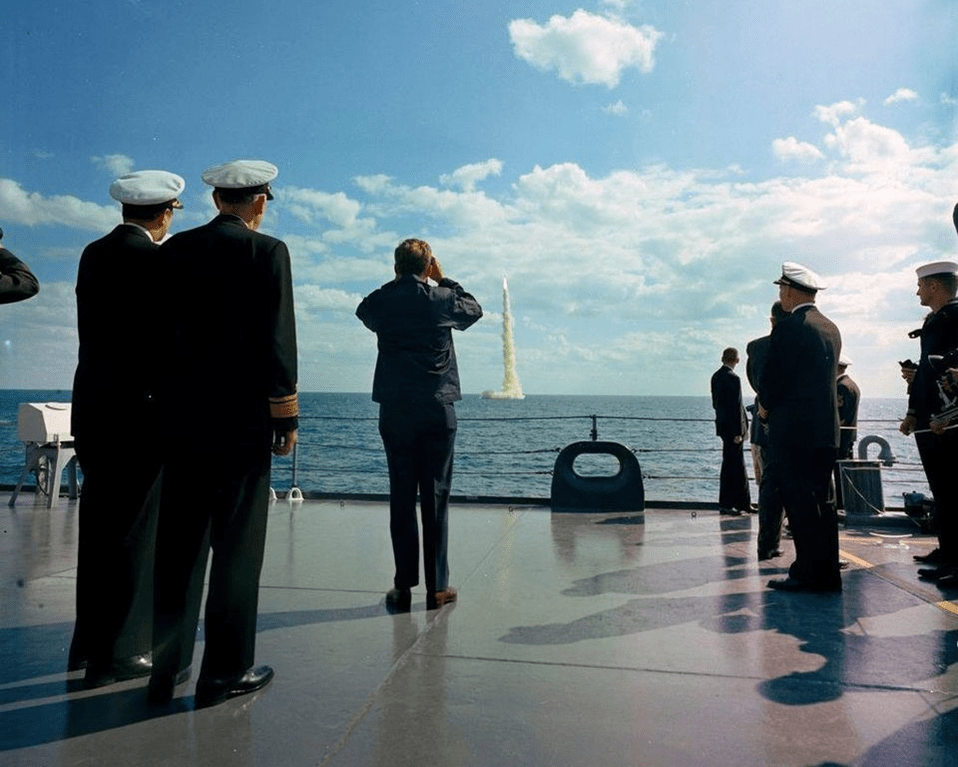
On November 16, 1963, just six days before his assassination, President John F. Kennedy stood aboard the USS Observation Island (EAG‑154) and witnessed a defining moment in the Cold War-era evolution of American sea power. Off the coast of Florida, he observed the successful launch of an unarmed Polaris A-2 missile from the LAFAYETTE-class submarine USS Andrew Jackson (SSBN‑619)—a vivid demonstration of the Navy’s burgeoning capability in sea-based strategic deterrence.
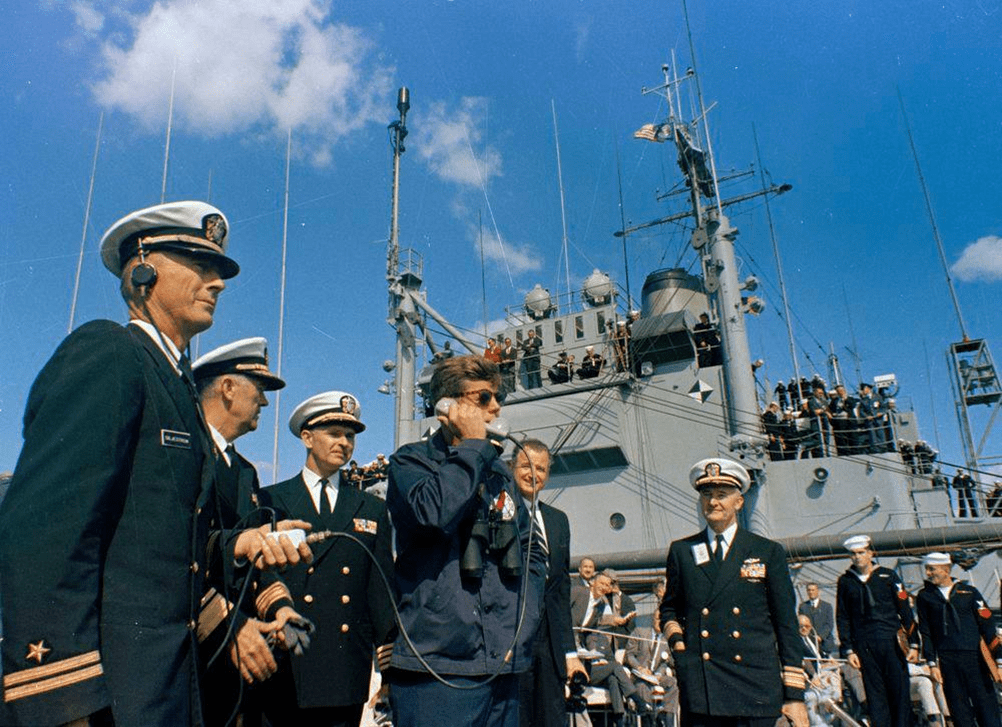
Alongside him on deck were several senior Navy leaders: Captain Roderick O. Middleton, commanding officer of the Observation Island; Rear Admiral Vernon L. Lowrance, Deputy Commander of the U.S. Atlantic Submarine Force; and Rear Admiral I. J. Galantin, Director of the Navy’s Special Projects Office. In a symbolic gesture, President Kennedy wore a windbreaker emblazoned with the insignia of both the Observation Island and Andrew Jackson—a gift from the crews of both ships. The visit was more than ceremonial; it was a presidential endorsement of a powerful new deterrent capability that would shape U.S. nuclear posture for decades.
From Cargo Vessel to Missile Testbed
Originally laid down on September 15, 1952, as the Empire State Mariner, a Mariner-class cargo ship, the vessel was launched in August 1953 and briefly operated under the U.S. Maritime Commission. She entered the Navy’s reserve fleet later that year.
On September 10, 1956, the ship was transferred to the U.S. Navy for conversion into a Fleet Ballistic Missile (FBM) test platform. Work began at Norfolk Naval Shipyard in 1957, transforming her into the Navy’s first fully integrated ship for testing the Polaris missile system. She was designated USS Observation Island (EAG‑154) and commissioned on December 5, 1958.

Her conversion included the installation of stabilizer fins, a single elevator-launch tube (later upgraded to two), and sophisticated navigation, guidance, telemetry, and data collection systems. This effectively turned her into a floating missile testbed, playing a critical role in the Navy’s transition to submarine-launched ballistic missiles (SLBMs).
Polaris and Poseidon Programs
In 1959, the Observation Island departed Norfolk, conducted a shakedown cruise at Guantanamo Bay, and participated in the first at-sea launch of a Polaris missile on August 27 near Cape Canaveral. Over the next decade, she would conduct six Polaris launches and then shift focus to submarine missile test support. As a communications and tracking relay, she provided essential data linkages between submerged submarines and range control ashore.
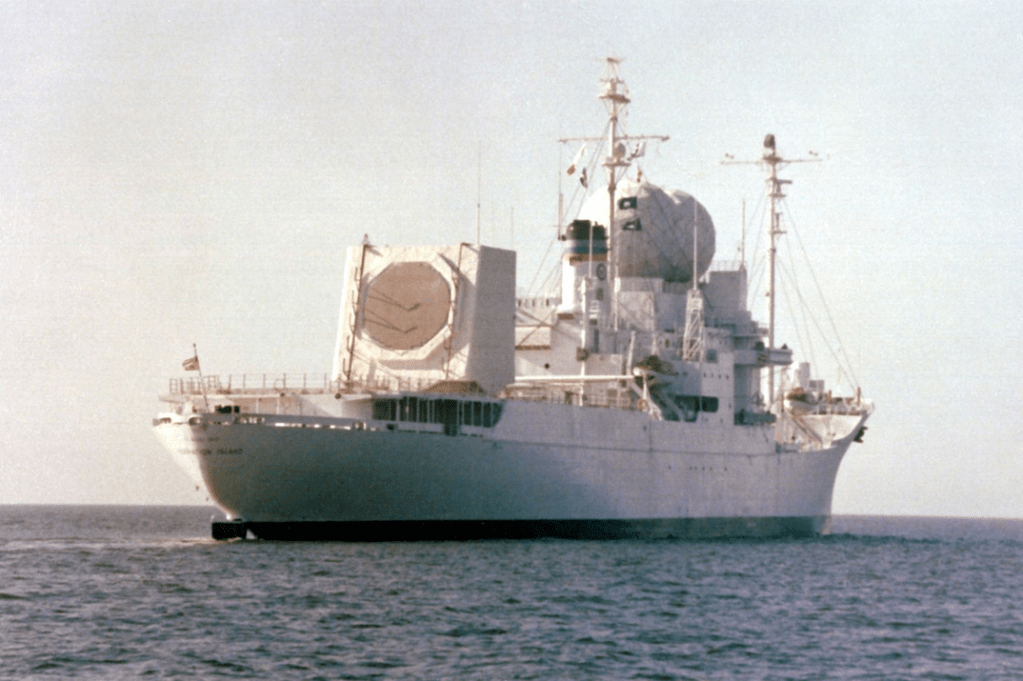
After her historic involvement in the Polaris program, the ship was redesignated AG‑154 on April 1, 1968, and underwent further conversion to support the Poseidon C‑3 missile system. She returned to Port Canaveral later in 1969 to assist in both submarine and land-based testing of the upgraded missile.
Cobra Judy and Treaty Verification
Decommissioned on January 1, 1972, the Observation Island returned to service under the Military Sealift Command on August 18, 1977, now redesignated USNS Observation Island (T‑AGM‑23). She was outfitted with the Cobra Judy system, an AN/SPQ‑11 phased-array radar, designed to collect detailed telemetry and tracking data on missile launches—a crucial capability for arms treaty compliance monitoring.
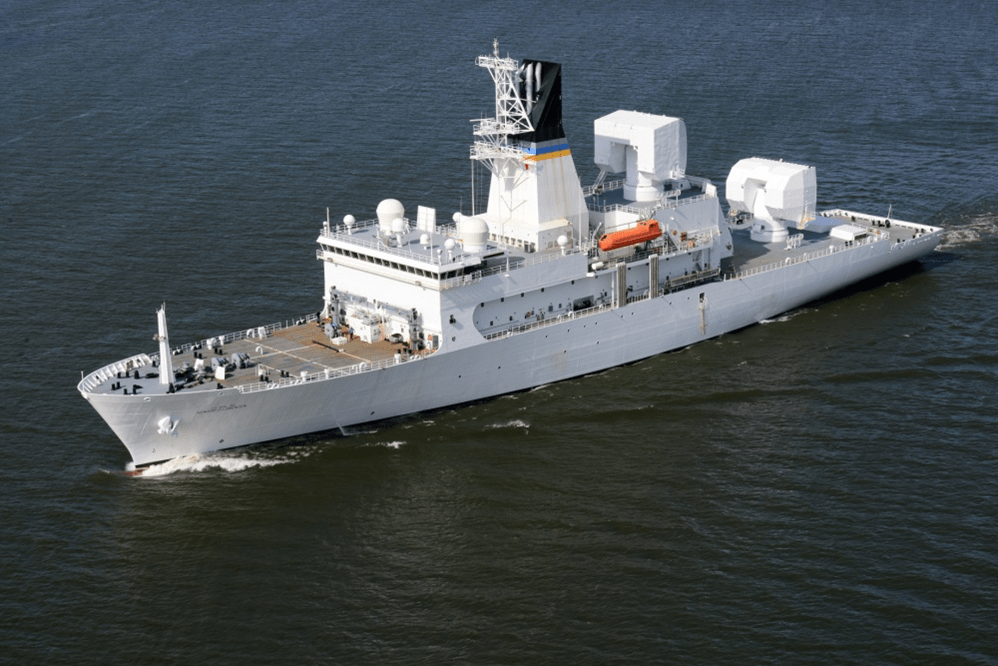
Over the next three decades, she became a workhorse of missile surveillance and treaty verification, averaging nearly 260 days at sea per year. Her work continued until 2012, when her mission was taken over by the USNS Howard O. Lorenzen.
End of Service, Enduring Legacy
The Observation Island was inactivated on March 25, 2014, struck from the Naval Vessel Register on March 31, and ultimately scrapped in mid‑2018. But her impact echoes far beyond her steel and sensors.
Today, the U.S. Navy Strategic Systems Programs (SSP) continues the mission she helped pioneer. The Trident II D5 missile, successor to Polaris and Poseidon, now forms one leg of the U.S. nuclear triad, alongside intercontinental ballistic missiles (ICBMs) and nuclear-capable bombers. Each leg is undergoing modernization to maintain the credibility of America’s strategic deterrence for decades to come.
From her beginnings as a cargo vessel to her role in ushering in the era of submarine-launched nuclear deterrence, the USS Observation Island stands as a symbol of innovation, adaptation, and enduring commitment to national security.
Featured image: During a visit aboard the United States Naval ship USS Observation Island (EAG 154), President John F. Kennedy (center left) watches a demonstration of the firing of a Polaris A-2 missile from the submarine USS Andrew Jackson (SSBN 619), at sea off the coast of Florida. Courtesy John F. Kennedy Presidential Library and Museum
 Station HYPO
Leave a comment