
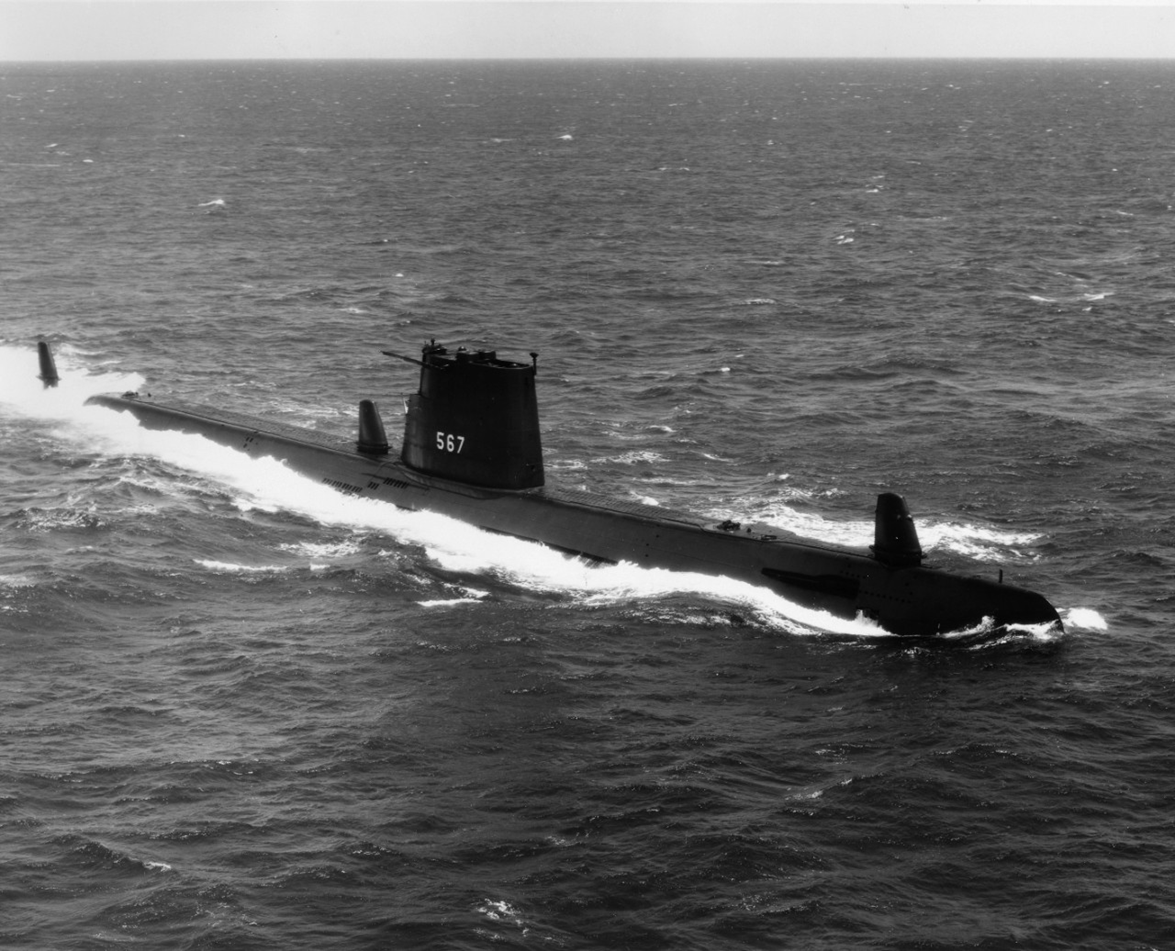
In the shadows of Cold War tensions, beneath the surface of the Sea of Japan, a little-known but significant event unfolded in August 1957 that marked a turning point in submarine espionage and international maritime confrontations. The USS Gudgeon (SS-567), a U.S. Navy submarine, became the first American submarine forced to surface by a foreign power during the Cold War—a moment that revealed the fragility of Cold War boundaries and the stakes of underwater intelligence gathering.
Tensions Beneath the Waves
At the height of Cold War surveillance missions, U.S. submarines frequently skirted the edges of Soviet territorial claims to monitor naval activity, radar signatures, and test ranges. The United States adhered to a 3-nautical-mile limit for territorial waters, while the Soviet Union claimed a 12-nautical-mile limit, a discrepancy that brought submarines like the Gudgeon dangerously close to confrontation.
In August 1957, the USS Gudgeon was conducting a covert reconnaissance patrol near Vladivostok, home to the Soviet Pacific Fleet. While the Gudgeon remained outside the 3-mile limit recognized by U.S. policy, it was operating within the 12-mile limit asserted by the Soviets—a calculated risk in an already tense region.

Detected and Surrounded
The submarine’s presence did not go unnoticed. Soviet naval forces, likely using a combination of surface sonar and aerial patrols, tracked and quickly surrounded the Gudgeon. What followed was an aggressive maneuver: Soviet warships and potentially aircraft pressured the submarine to surface, a direct and rare challenge to U.S. naval operations.
Faced with overwhelming force and the potential for escalation, the commanding officer of the Gudgeon made a fateful decision—the submarine surfaced, in full view of Soviet forces. No weapons were fired, and no shots exchanged, but the message was unmistakable.
A Moment of Embarrassment and Secrecy
The incident, while highly provocative, was kept secret from the public and likely classified by U.S. authorities at the time. It was a clear embarrassment for the U.S. Navy, not only for being detected but for being compelled to surface in contested waters. The incident underscored the growing capabilities of the Soviet Navy and their willingness to defend their maritime claims, even at the risk of triggering a larger conflict.
The Gudgeon’s surfacing became a symbolic turning point—an early Cold War warning about the dangers of underwater brinksmanship and the thin margin separating routine reconnaissance from potential escalation.
Legacy
Though long overshadowed by later submarine confrontations and intelligence operations, the 1957 Gudgeon incident remains a historical first—the beginning of a series of increasingly bold and risky undersea encounters between the world’s superpowers. It reflects the silent, high-stakes cat-and-mouse games that defined Cold War naval strategy and the importance of submarine operations in maintaining (or disturbing) the balance of power.
As technology advanced and the oceans became a front line for surveillance and deterrence, the Gudgeon’s story stands as an early reminder of just how close the world sometimes came to the edge—without a single shot fired.
 Station HYPO
6 July 2025 at 14:45
Definitely a secret!
LikeLike
6 July 2025 at 21:36
This is new one for me. Wonder what happened the Skipper? I would think this would be on the same level as a Surface Skmmer running aground.
LikeLike