
The only satisfactory method of ensuring unity of effort lies in due preparation of the minds of the various commanders, both chief and subordinate, before the outbreak of hostilities. Such preparation comprehends not only adequate tactical and strategic study and training, but also a common meeting ground of beliefs as to the manner of applying principles to modern war.
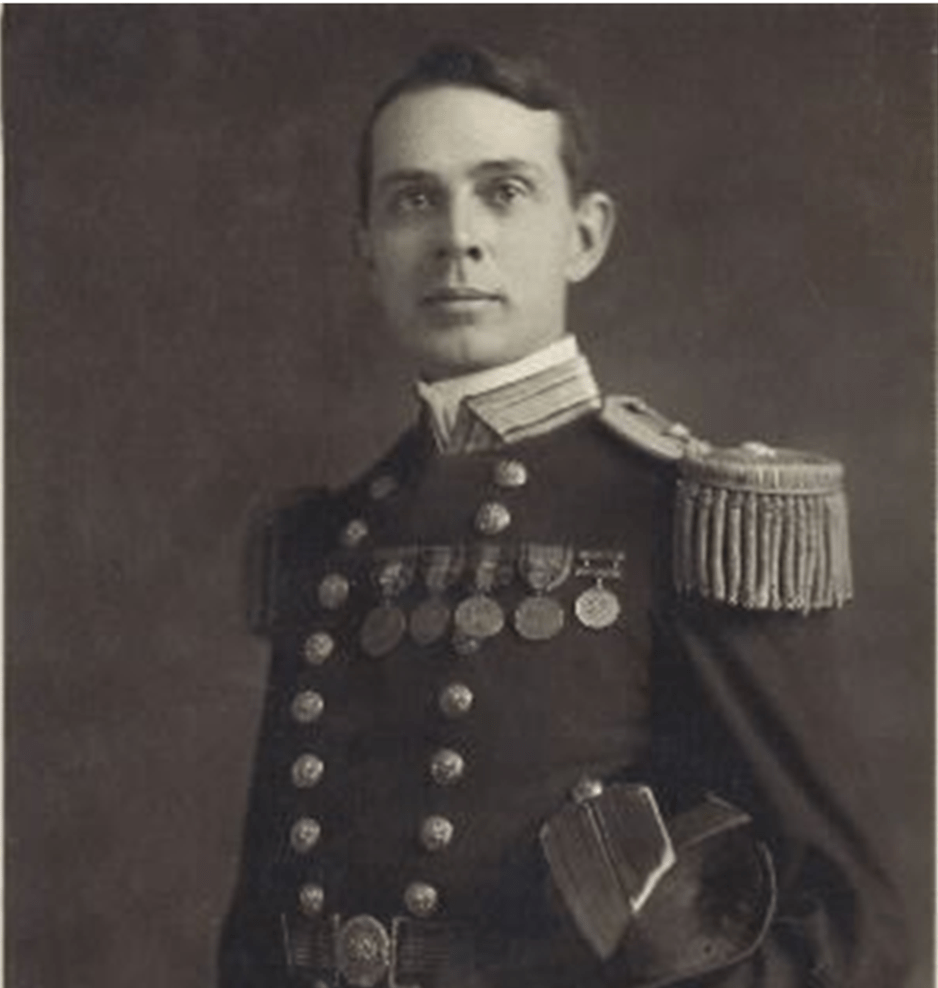
Dudley Wright Knox
21 January 1877 – 11 June 1960
Bibliography of Writings of Commodore Knox
Dudley Wright Knox was born in Fort Walla Walla, Washington, on 21 Jun 1877, the son of Colonel Thomas Taylor Knox, USA, and Mrs. (Cornelia Manigault Grayson) Knox. After attending high school in Washington, DC, he entered the US Naval Academy on appointment from the Ninth District of Tennessee on 6 Sep 1892. He was graduated on 5 Jun 1896, and following the two years at sea then required before commissioning, he was commissioned Ensign on 6 May 1898. Subsequently, he attained the rank of Captain to date from 1 Feb 1918. He was transferred to the Retired List of the Navy in that rank on 24 Oct 1921, but continued on active duty until relieved on 26 Jun 1946. He was advanced to the rank of Commodore on the Retired List, to date from 2 Nov 1945.
Following graduation from the Naval Academy, he had duty as a Passed Midshipman on USS Massachusetts and upon outbreak of the Spanish-American War was commissioned as Ensign and transferred to USS Maple, serving in Cuban waters until the defeat of Spanish forces. He was then transferred to the receiving ship, Independence, at Mare Island, California, serving from 25 Aug to 1 Nov 1898, and then to USS Yorktown which proceeded to Manila and engaged in operations against the Philippine Insurrection. During this insurrection he later commanded USS Albay and USS Iris, which also participated in the Boxer Rebellion Campaign.
Relieved of command of Iris in June 1901, he reported for a tour of duty as an Inspector of Ordnance at Brooklyn, New York. Then followed four years in the First Torpedo Flotilla comprising the first destroyers of our Navy. In this he successively commanded Shubrick, Wilkes, Decatur and the Flotilla itself, which crossed the Atlantic and went to the Philippines and the coasts of China. Subsequently he was Ordnance Officer of USS Nebraska during the Atlantic Fleet’s cruise around the world, and then served as Aide to the Commandant of the Mare Island Navy Yard.
Thereafter he had duty as Fleet Ordnance Officer of the Atlantic, and later the Pacific Fleet; attended the Summer Conference of Officers and upon graduation remained for duty at the Naval War College in 1912-1913; and served as Aide on the staff of Commander, Atlantic Torpedo Flotilla, 1913-1914. On 25 Nov 1914 he reported for duty in the Office of Naval Intelligence, Navy Department, Washington, DC, where he served until 20 Apr 1916.
Assigned duty as Commandant, Naval Station, Guantanamo Bay, Cuba, he served in that capacity through the early period of World War I until August 1917 when he returned to the Navy Department for brief duty in the Office of the Chief of Naval Operations. He was detached on 22 Nov 1917 and proceeded to London, England, to join the staff of Commander, US Naval Forces Operating in European Waters. There he served first as Aide in the Planning Section, and later in the Historical Section, attached successively to Melville and Corsair. He was awarded the Navy Cross for “distinguished service in the line of his profession while serving on the Staff of Commander, US Naval Forces Operating in European Waters.” Also, for meritorious service in that capacity he was awarded the Companion of the Order of St. Michael and St. George by the Government of Great Britain, and the Cross of St. Maurice and St. Lazarus by the Government of Italy.
Source: history.navy.mil
 Station HYPO
Leave a comment