
On May 4, 1917, less than a month after the United States declared war on Germany, the first U.S. combat forces arrived in Europe to join the First World War, a devastating conflict raging since August 1914. Under the command of Commander Joseph Taussig, six U.S. Navy destroyers reached Queenstown, Ireland, marking a pivotal moment in the war effort.
In the spring of that year, the Allied situation was dire. German U-boats were conducting unrestricted submarine warfare, sinking merchant ships at an alarming rate. The United Kingdom, heavily dependent on imported supplies, faced a severe crisis—its food reserves dwindled to only a few weeks’ worth. The Royal Navy, stretched thin and desperately short of destroyers to combat the U-boat menace, urgently requested U.S. naval support as soon as the U.S. entered the war.
Rear Admiral William S. Sims, the U.S. Navy representative to the Royal Navy, sent an urgent cable to Washington on April 14, 1917, emphasizing that the crisis was even worse than initially reported. He recommended the immediate dispatch of U.S. destroyers. That same day, Taussig’s squadron was ordered to sail from Yorktown to New York and then Boston, where they prepared for their unrefueled trans-Atlantic crossing. Departing Boston on April 24, the delay was not due to readiness—Taussig’s ships were prepared—but rather to policy deliberations in Washington. For over a century, U.S. Navy ships had deployed to distant regions on short notice; when the call came, the U.S. Navy answered.
Upon reaching Queenstown, the local Royal Navy Admiral asked Taussig when his destroyers could begin operations. Taussig’s confident reply—reported in newspapers as “We are ready now, sir,” though slightly paraphrased—was a significant morale boost for the British during a critical period. Within days, U.S. destroyers were actively combating U-boats, and within two months, over 30 additional U.S. destroyers had joined the fight. Alongside these reinforcements, the U.S. Navy introduced innovations such as underway refueling and radio-telephones while adopting British advancements like depth charges, forming an effective anti-submarine strategy.
By the end of the war, over two million U.S. Army troops had safely crossed the Atlantic, transported and protected by the U.S. Navy. These reinforcements helped break the stalemate and secure an Allied victory, achieved at great cost on land but with minimal losses at sea.
This cooperation between the U.S. Navy and the Royal Navy marked a turning point in their relationship. For over a century prior—since the Revolutionary War and the War of 1812—the two navies had been adversaries, with little goodwill between them. However, the professionalism and fighting spirit of the U.S. Navy had earned the Royal Navy’s respect. In 1917, First Sea Lord Admiral Sir John Jellicoe, the victor of the Battle of Jutland, welcomed Taussig with high praise, writing:
“There is no Navy in the world that can possibly give us more valuable assistance, and there is no personnel in any Navy that will fight better than yours.”
Jellicoe’s words held true in 1917 and remain so today. The legacy of the U.S. sailors who turned the tide in World War I endures, shaping the enduring partnership between the U.S. Navy and the Royal Navy—a bond forged in crisis and strengthened over the century since.
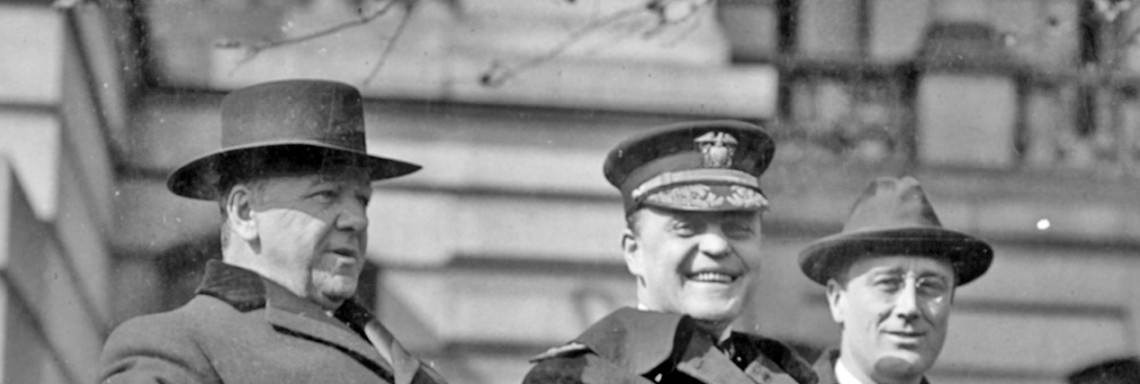
Featured image: WWI U.S. Navy and Marine Corps Leaders
Secretary of the Navy Josephus Daniels and Chief of Naval Operations Admiral William S. Benson led the U.S. Navy during World War I. Admiral Benson was the first Chief of Naval Operations following establishment on March 3, 1915. Franklin D. Roosevelt, the future thirty-second President of the United States, served as Assistant Secretary of the Navy. Vice Admiral William S. Sims was quickly, and secretly, dispatched to liaison with the British Admiralty, arriving on April 9. Remaining in London, he served as Commander, United States Naval Forces Operating in European waters. Consulting with the British, he recommended the most effective use of the U.S. Navy. Once in London, Sims learned the German U-Boat situation was drastically more serious than originally told by the British. If the merchant ship loss continued, Britain would have been starved by November. To lead the fight with the enemy in Atlantic and European waters, Admiral Henry T. Mayo was ordered to become Commander in Chief of the Atlantic Fleet.
Image: NH 57088: Honorable Josephus Daniels with Assistant Secretary of the Navy Franklin D. Roosevelt. U.S. Naval History and Heritage Command Photograph.
 Station HYPO
Leave a comment