
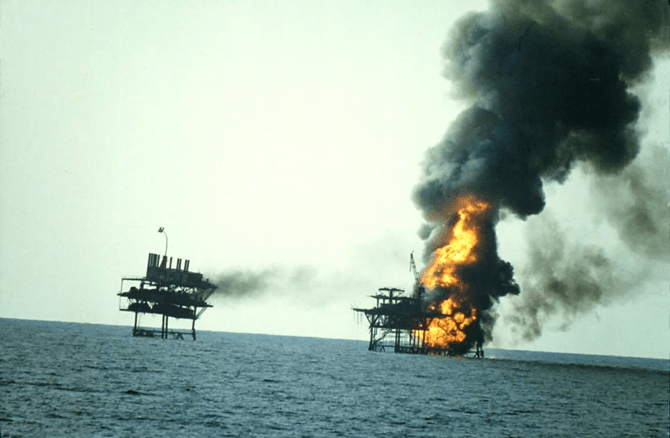
On April 18, 1988, the U.S. Navy launched Operation Praying Mantis, one of the largest surface naval engagements since World War II. The operation was a direct response to the Iranian mining of the USS Samuel B. Roberts (FFG-58), a guided-missile frigate that had struck a mine in the Persian Gulf on April 14, 1988. This naval action significantly escalated tensions between the United States and Iran and had lasting implications for maritime security in the region.
Background: The Iran-Iraq War and U.S. Involvement
The roots of Operation Praying Mantis lie in the broader context of the Iran-Iraq War (1980-1988), a bloody and protracted conflict between Iran and Iraq that affected the entire region. By the mid-1980s, both nations had attacked each other’s oil infrastructure, dragging neutral shipping into the conflict. Iran, in particular, began targeting oil tankers transiting the Persian Gulf as part of its strategy to weaken Iraq’s economy, leading to the so-called “Tanker War.”
In response to Iranian aggression, the United States launched Operation Earnest Will in 1987, a mission to escort Kuwaiti oil tankers through the Gulf, many of which had been reflagged under the U.S. flag to deter attacks. Despite these efforts, Iranian forces used small boats and mines to disrupt shipping. As tensions mounted, the U.S. Navy increased its presence in the region, patrolling the waters to protect commercial vessels.
The Mining of USS Samuel B. Roberts
On April 14, 1988, USS Samuel B. Roberts was escorting tankers as part of Operation Earnest Will when it struck an Iranian mine in the central Persian Gulf. The explosion ripped a large hole in the ship’s hull and caused a massive fire onboard. Despite the severe damage, the crew of the Roberts managed to control the situation, preventing the ship from sinking. The explosion injured ten sailors, but there were no fatalities.
The Samuel B. Roberts was severely crippled, and the subsequent investigation found that the mine had been laid by Iran, marking a direct and deliberate threat to U.S. naval operations. This prompted a forceful response from the United States.
Operation Praying Mantis: April 18, 1988
Four days after the mining of USS Samuel B. Roberts, the U.S. Navy launched Operation Praying Mantis to retaliate against Iranian forces. The goal of the operation was to cripple Iran’s naval capabilities and send a clear message that attacks on U.S. forces and interests would not be tolerated.
The operation unfolded in three phases:
Strikes on Iranian Oil Platforms: The U.S. attacked two Iranian oil platforms in the Sirri and Sassan oil fields, which were being used as military outposts to harass shipping in the Gulf. U.S. warships, including destroyers and cruisers, bombarded the platforms, while U.S. Marines and SEAL teams landed to ensure the destruction of military equipment. Iran had been using these platforms as bases to coordinate attacks on neutral shipping.
Naval Engagements: Iranian forces responded to the strikes by launching attacks against U.S. warships with their fast-attack boats and missile-armed ships. In retaliation, U.S. forces sank or severely damaged several Iranian vessels. The Iranian frigate Sahand was sunk after engaging U.S. warships with surface-to-air missiles. The frigate Sabalan was also heavily damaged and only spared from destruction after President Ronald Reagan ordered U.S. forces to hold back, providing a stark demonstration of U.S. restraint amidst overwhelming firepower.
Air Engagements: U.S. forces also launched air strikes against Iranian installations and vessels. The coordination between surface and air forces during the operation highlighted the strength and flexibility of the U.S. Navy.
By the end of Operation Praying Mantis, Iran had suffered the loss of multiple vessels, including the Sahand and other smaller boats, as well as damage to several oil platforms. The U.S. had successfully delivered a powerful blow to Iranian naval forces, reinforcing its dominance in the region.
International Concerns and Fallout
The operation drew international attention as it risked further escalating the Iran-Iraq War and potentially dragging other nations into the conflict. However, the swift and decisive nature of Operation Praying Mantis had the effect of deterring further Iranian aggression against U.S. forces. Iran, already exhausted by its war with Iraq, realized it could not afford a direct confrontation with the United States, leading to a significant reduction in hostilities in the Gulf.
Iranian officials condemned the U.S. actions as unjustified and claimed that the oil platforms were not being used for military purposes. However, intelligence suggested otherwise, and the global community largely viewed the U.S. operation as a proportionate response to Iran’s aggressive tactics in the Gulf.
Operation Praying Mantis also had a lasting impact on U.S.-Iran relations, with the two countries continuing to engage in a tense, often adversarial, relationship in the years that followed. Iran eventually adopted more indirect tactics, such as supporting proxy groups, while the U.S. remained vigilant in protecting its interests in the Gulf.
Casualties and Aftermath
While the USS Samuel B. Roberts did not suffer any fatalities, ten sailors were injured. The ship was eventually towed to Dubai for temporary repairs before being sent to the United States for full restoration. The successful containment of damage to the Roberts and the heroism of the crew in saving their ship earned them recognition and honors, including the Navy Unit Commendation.
On the Iranian side, the losses were far more significant. Iranian forces suffered the destruction of several vessels and the incapacitation of military infrastructure on the oil platforms. Estimates suggest that several dozen Iranian personnel were killed during the engagements, although official numbers remain unclear.
Conclusion
Operation Praying Mantis stands as a crucial moment in U.S. naval history and a turning point in U.S.-Iran relations. The operation demonstrated the U.S. Navy’s capability to project power in response to threats against its forces, while also reinforcing the importance of protecting the flow of oil through the Persian Gulf. Although it did not end the broader conflict between the U.S. and Iran, it marked a decisive U.S. victory in the ongoing struggle for control of Gulf waters.
References:
- Cole, C. M. (2003). Operation Praying Mantis: An Analysis of the U.S. Navy’s Strike against Iranian Forces in the Persian Gulf, April 1988. Naval War College Review, 56(3), 83-110.
- Chubin, S., & Tripp, C. (1988). Iran and Iraq at War. Westview Press.
- Polmar, N., & Moore, J. (2003). Cold War Submarines: The Design and Construction of U.S. and Soviet Submarines. Brassey’s.
- New York Times. (1988). U.S. Attacks Iranian Oil Platforms and Ships. April 19, 1988.
 Station HYPO
18 April 2025 at 20:35
just FYI – I tried to find the CM Cole article in NWCR and its not in any of Vol 56 nor can it be found by searching on the author’s name or article title. As Sergeant Shultz would say, “Verrrrryyyy Innnterrresting.”
LikeLike
18 April 2025 at 22:23
This article that was written for Station HYPO was written several months ago and the article cited as a reference was available at the time. Unfortunately, the NWCR website has technical issues as stated in the following comment on their website:
“Please note that, due to an incompatibility between current and historic NWC Review publishing patterns, published issue information may not correspond with the displayed information. We apologize for any confusion.” https://digital-commons.usnwc.edu/nwc-review/
LikeLike
18 April 2025 at 22:34
Thanks, Mario, missed that (obviously!)
LikeLike