
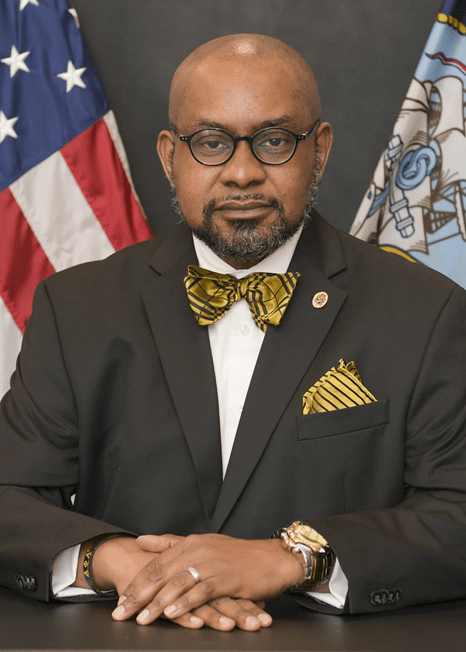
While on leave in 2006, I found myself in a bookstore on Atlanta’s West End. Looking around, I found a book written by Adolph W. Newton entitled Better than Good: A Black Sailors War, 1943-1945. The title was intriguing, so I bought it and took it back to Pensacola with me.
After reading the book, a comment a white Chief Petty Officer—CPO—made in 1995 made even more sense. I just arrived at the airport in San Diego for my initial duty assignment on USS Rentz FFG-46 and was headed to baggage claim. He recognized my rating badge and said to me, “you’re going to have to work harder to be recognized and you may not see a lot of people who look like you in your rate but don’t give up.”
At every command I’ve been privileged to serve, I experienced a little racial tension. From an E3 who used racial slurs towards me (until we had an actual fire onboard and we had to work together) to an Executive Officer who invited the Ward Room to her house for a Hail and Farewell and never spoke to me the entire night, even after I spoke to her. Having said that, I’m glad to have witnessed a change in the racial atmosphere the longer I stayed in and the higher I rose in rank.
As an EW1, an LDO gave me a valuable piece of advice when I was selected for CPO. He told me that I would encounter good as well as bad leaders, learning from both will make me a better leader. During my 21+ years in the Navy, I experienced good as well as bad leadership styles/examples and I learned from both. Most of the good leadership examples were experienced while on shore duty while most of the bad examples happened while at sea, not every ship just two of them.
Two experiences I had at one command almost caused me to get out at the end of my second enlistment. One was a Division Officer—DIVO—who blatantly treated me differently from the other guys in the division to the point where other people on the ship—officer and enlisted— noticed. He tried to deny my request to take the CPO exam early stating I did not have enough time even after the PNCM said I was eligible. The Ops Boss made him change his recommendation—I still have a copy of that request.
It got so bad at one point the Ops Boss pulled me from the Division to work directly for him. When I was selected for CPO, although he had transferred, the DIVO contacted leadership and told them to pull my recommendation. At the same command, a junior Sailor decided to script an email telling me he was not going to do anything I told him to do. When I showed it to the DIVO, he smirked and walked off without addressing it—I still have a copy of that email. One thing that I can say about my experiences in the U.S. Navy is that I met a few people that I will not miss if I never see them again, but I met more people that I often think about and follow on social media and some that I have great memories of but when it comes to remembering their names, my memory seems to fail me.
One specifically was a white CTRC stationed at Corry Station with me who nearly lost it when he heard a young white Sailor refer to blacks as antiquated slave equipment. He was a history buff and wanted to read the book mentioned earlier. Since I was about to transfer and had already read it, I signed it and gave it to him. He was one of the great Sailors I had the pleasure of serving with and taught me that brothers come with varying amounts of melanin and from all walks of life. We shared an office, laughs, and conversations about everything from the changing make-up of the Navy to racial and gender disparities within the ranks of the Navy.
Another Sailor was a DIVO I had while on shore duty who saw something in me that I did not see. I was determined to be the first Black Master Chief Petty Officer of the Navy—MCPON—but he saw another path of leadership for me as a Chief Warrant Officer—CWO. He stopped by my office every day for about a week talking to me about the CWO program. Every day I told him I wanted to be a MCPO, then one day he came in and shifted his rudder.
Instead of trying to talk me into applying for CWO, he told me I was going to be selected for something that year, Senior Chief or CWO then asked me what I would do if I didn’t get selected for MCPO, as over the years he saw many Sailors get stuck at E8 in his career. The conversation centered around people who missed opportunities for advancement because they failed to explore other options. One of the last things he said to me that day was not to limit my possibilities. I was the last to apply at the command and the only first-time candidate selected.
Over the years, I’ve had really good and really bad experiences as well as leadership, but every experience was a learning one that helped me as a leader and as a person. One of the most valuable lessons that I learned over my time in the Navy was how to pull life lessons from the good and the bad, not only for my well-being and professional development, but to pass on to younger Sailors who would be our future leaders.
As a retired CWO and a Civilian employee on a Navy Base, I have the privilege of working with Sailors every day. I say privilege because I get the opportunity to sit and talk with them every day. I get to share my experiences with them and quite a few of them come to me for career advice. Besides serving on active duty, one of my greatest experiences is being able to support Sailors as a retiree.
Over the years, I’ve given away many copies of the book mentioned earlier to young black Sailors. Before giving them a copy, I sat with them and talked about the sacrifices made by black Sailors who served before during war torn years who cleared a path for us. I would then tell them to strive to continue to blaze trails for all Sailors who would come after us. If I had to do it all over again, I’m not sure how much I would change because even my mistakes and bad decisions helped me in the long run to be a better follower and a better leader.
Rev. Dr. James E Prioleau, II, D Min.
CWO3 Retired, USN
 Station HYPO
5 February 2025 at 14:31
Excellent article, thank you for sharing.
LikeLike