
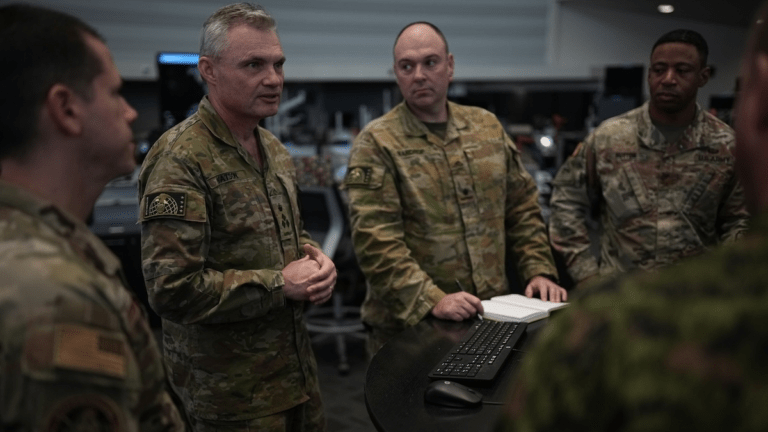
What if I told you a major U.S. Department of Defense component assumed responsibility for building a critical warfighting capability negligently disregarded this duty, and ultimately allowed this capability to reach a point of failure? Well, that’s exactly what happened with U.S. Cyber Command.
Continue reading “The Sad and Sorry Tale of Cyber Command’s Seven-Year Failure”
Sept. 5, 2025
When President Xi Jinping presided over an enormous exhibit of China’s military might in Beijing on Wednesday, there were more than fighter jets and missiles on display.
Continue reading “A Project for a New World Order”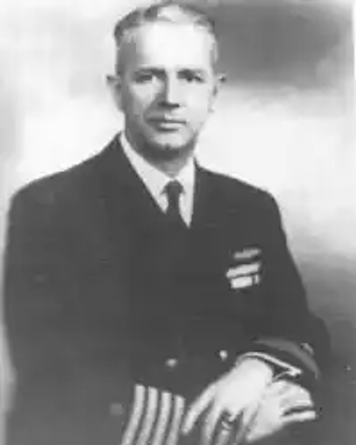
Featured image: Captian Laurance Safford, USN
There were no problems of collaboration for strictly military COMINT matters where each service was working alone in its proper sphere of activity. The Navy COMINT team did a thorough job on the Japanese Navy with no help from the Army. [Redacted] No assistance was requested from the Army other than permission to establish a Navy COMINT Unit on Corregidor. The Navy gave the Army all its Japanese Army intercepts, assisted in training an Intercept Unit at Manila, never denied the Army any legitimate information it requested, and gave the Army all the help it was willing to accept. The Army, in turn, provided the Navy copies of all its technical cryptanalytical manuals and training courses.
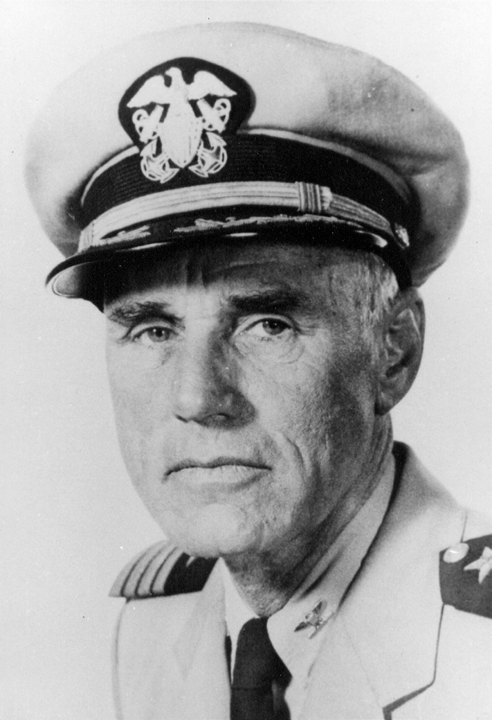
Featured image: CAPT Prescott Hunt Currier, USN
On 1 June 1939 the Japanese Navy introduced a new type of numerical code referred to by Navy COMINT personnel as AN, JN-25 or the Operations Code. This code used a vast number of “additives” (or subtractor) keys, similar to the [redacted] used by the U.S. [redacted] Navies from 1941 through 1943. Mrs. Driscoll and Mr. Currier spear-headed the attack and we were soon [redacted] reconstructing the code. Recovery of the additive keys, however, involved much more labor and required many more crypto-personnel than the earlier transposition keys. Main work of solution was undertaken at Washington. By December 1940 we were working on two systems of keys used with this code book: the “old” keys for code recovery and the “new” keys for current information. In the spring of 1941, the U.S. COMINT Unit at Corregidor polled its effort with [redacted]. The [redacted] had also reconstructed this Japanese Number Code to a partially readable extent and wre busy recovering keys and “filling in the blanks” in the code.

President Xi Jinping declared China’s “great rejuvenation” unstoppable on Wednesday as he used the country’s largest-ever military parade to hint at reunification with Taiwan and to flaunt advanced weapons designed to rival American power.
Continue reading “Xi Jinping hails ‘unstoppable’ China as Trump accuses Beijing of conspiring against US”
Featured image: Mrs. Agnes Driscoll
The collaboration between the Army and the Navy on Japanese Diplomatic crypto‑systems did not extend to the Japanese Military (Army and Navy) crypto‑systems. A secret divulged to a third party is no longer a secret. The U.S. Navy withheld all details of its success with Japanese Naval crypto‑systems from the Army and in turn made no inquiries about the Army’s progress with Japanese Army crypto‑systems. When the Japanese Army invaded Manchuria in 1931 the U.S. Navy intercept station at Peking (manned by Marine Corps operators) went to watch‑and‑watch condition and obtained a wealth of tactical intercepts. These were all turned over to the War Department for exploitation ‑ and no embarrassing questions were ever asked.
 Station HYPO